London
Around the World in Eighty DaysLondon is both Phileas Fogg’s home and the fixed endpoint that gives his journey its measure. The city is not primarily presented as a place to tour: it is the address he leaves, the deadline against which every connection is calculated, and the setting in which his apparent failure becomes a victory. Its significance lies in that double function—as an ordinary point of departure and as the destination whose clock seems, at first, to pronounce judgment on the wager.
Home and Social Setting
In 1872, Phileas Fogg lived at No. 7, Saville Row, Burlington Gardens, in the house where Sheridan had died in 1814. That precise address places him within London before the journey has made him a figure of international movement. Yet the narrative offers little domestic description beyond the location itself and the biographical association with Sheridan. London is established through a point on the map, not through an extended portrait of the house or its neighborhood.
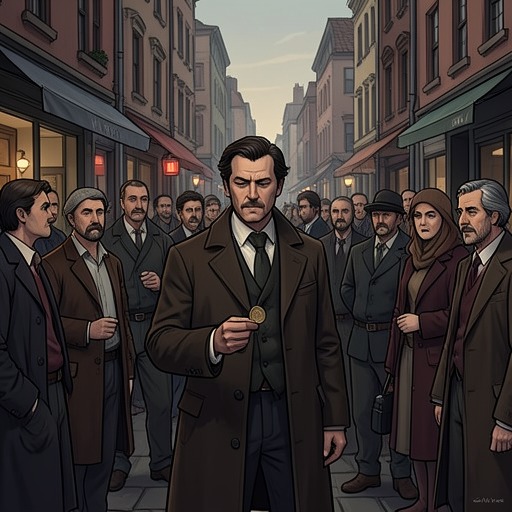
Fogg’s other defining London association is the Reform Club, where he is one of the most noticeable members while seeming to avoid attention. The contrast makes the club a useful social counterpart to his residence: it identifies his world and status, but the account emphasizes how little others know about him. He is described as an enigmatic, polished man of the world, and London supplies the setting for that public identity without resolving the mystery around it. The city is thus tied to both his private address and his familiar social circle, two fixed points from which his extraordinary undertaking departs.
The City as Departure Point and Deadline
The wager converts London into a precise temporal destination. Fogg calculates that, leaving on Wednesday, 2 October, he must be back in the same Reform Club room on Saturday, 21 December, at a quarter before nine in the evening. He names the date and hour after consulting a pocket almanac, and stakes a cheque for twenty thousand pounds, deposited in his name at Barings Bank. The sum represents half his fortune; he anticipates that carrying out the project may require him to spend the other half. The journey is therefore not an open-ended adventure but an undertaking bounded by a London address, a public deadline, and a substantial financial risk.
The departure follows immediately. The train for Dover is due to leave at a quarter before nine that very evening, and Fogg says he will take it. At twenty minutes before nine, he and Passepartout are seated in a first-class carriage; five minutes later, the train moves out of the station. The compact sequence makes departure itself part of the wager’s precision. London is not just where the plan is announced: it is where the first connection must be made, and where Fogg’s measured routine becomes motion.
A Fixed Point in the Route’s Calculations
As the journey proceeds, London remains present through projected arrival times rather than through descriptions of the city. Aboard the General Grant, Fogg calculates that he may reach San Francisco on 2 December, New York on the 11th, and London on the 20th, gaining several hours before the fatal deadline of 21 December. The itinerary’s far-flung places matter in relation to this final estimate. Each arrival elsewhere becomes a step in a calculation whose destination is still London.
The importance of that timetable becomes especially sharp in New York. On 12 December, nine days, thirteen hours, and forty-five minutes remain before the agreed deadline. Fogg reckons that passage on the China, one of the fastest Atlantic steamers, would have carried him to Liverpool and then London within the allotted period. The calculation makes clear how little slack remains: a feasible transatlantic route depends on finding the right vessel, while the calendar continues to narrow the time available. London is a city not yet reached, but already present as a constraint on every choice.
Return and Reversal
The final approach makes the city’s clocks seem to settle the wager. After setting out for London with Aouda and his faithful servant, Fogg has only five and a half hours for the journey. Forced delays intervene. When he steps from the train at the terminus, the clocks are striking ten minutes before nine—five minutes later than the quarter-to-nine deadline. The narration states that he has completed the tour of the world but is five minutes behind, and declares that he has lost.
That apparent verdict is overturned at the Reform Club. Passepartout seizes Fogg by the collar and drags him out; Fogg reaches the club by cab, and the clock in its great saloon indicates a quarter before nine when he appears. The story then declares that he has completed the journey in eighty days and won the twenty-thousand-pound wager. The shift from the station’s late clock to the club’s deadline makes London’s geography part of the ending: arrival in the city alone is not enough; the decisive return is to the room where the terms were set. London thus closes the circuit, but not as a passive finish line. Its rooms, timetable, and clocks organize the wager’s stakes—and the final return changes what seemed to be a loss into a win.